


Compensation for independent energy storage capacity in Hubei: 165 yuan/kW · year, shared by industrial and commercial users, electrochemical<240 times, compressed air<180 times, and 20% of the annual capacity electricity fee recovery.
On January 4th, the Hubei Provincial Development and Reform Commission and Provincial Energy Bureau issued a notice on establishing a new energy storage pricing mechanism. Effective from February 1, 2026, with a tentative implementation period of one year.
Establish an independent energy storage capacity compensation mechanism on the grid side, and projects that enjoy capacity compensation are not allowed to lease capacity. Regularly publish a list of grid side independent energy storage projects included in the capacity compensation scope. The execution standards for capacity compensation are as follows:
The monthly capacity electricity fee is determined based on the monthly capacity electricity fee and the monthly average available capacity。
Among them, monthly capacity electricity price=annual capacity electricity price/12, and the annual capacity electricity price is temporarily implemented at 165 yuan/kilowatt · year;
Monthly average available capacity=∑ (daily available discharge power x single sustainable discharge duration ÷ 10 hours)/total number of days in the month.
The parameters related to monthly average available capacity shall be declared by the new energy storage project to the power dispatching agency before the following month (which can be adjusted in advance), and shall be recognized by the power dispatching agency in accordance with the relevant rules of coal-fired power capacity pricing. Please note that when calculating the available capacity, the discharge duration is calculated as 10 hours, which is equivalent to 10 hours. For a 2-hour system, if the available discharge power is equal to the rated power, then the available power=1/5 of the rated power, and the capacity electricity price becomes 33 yuan/kW · year. The maximum annual capacity compensation fee for a 100MW/200MWh power station is 3.3 million yuan, which may only cover the operation and maintenance costs.
If the equivalent charging and discharging frequency of the project is low throughout the year (less than 240 times for electrochemical energy storage and less than 180 times for compressed air energy storage), 20% of the annual capacity electricity fee will be recovered and used to offset the system operation fee.
全年等效充放电次数=(实际充电量+实际放电量)/(额定充电量+额定放电量)。
Priority will be given to scheduling and operating new energy storage systems that participate in the market based on market clearing results; For new energy storage systems that have not participated in the market, it is necessary to coordinate factors such as system safety regulation and clean energy consumption needs.
During the period when the new energy storage does not participate in the market, the power grid enterprise matches the charging amount of the new energy storage with the source of electricity, and the price difference profit and loss are included in the system operation fee; The discharged electricity is used as a proxy source for purchasing electricity and is uniformly purchased by the power grid enterprise. Power grid enterprises should provide fair transmission and distribution, grid access, and metering services for new energy storage, and settle electricity bills in accordance with regulations.
New energy storage systems built within new energy stations that are not directly connected to the public power grid should participate in the spot market according to rules, implement the same power generation and consumption pricing policies as the new energy stations they belong to, and settle electricity bills as a whole.
The new type of energy storage on the user side is regarded as a whole with its affiliated users, and its electricity consumption attributes are consistent with those of the affiliated users. The charging price follows the same pricing mechanism as the affiliated users, and in principle, it does not actively discharge to the power grid.
The original text is as follows:
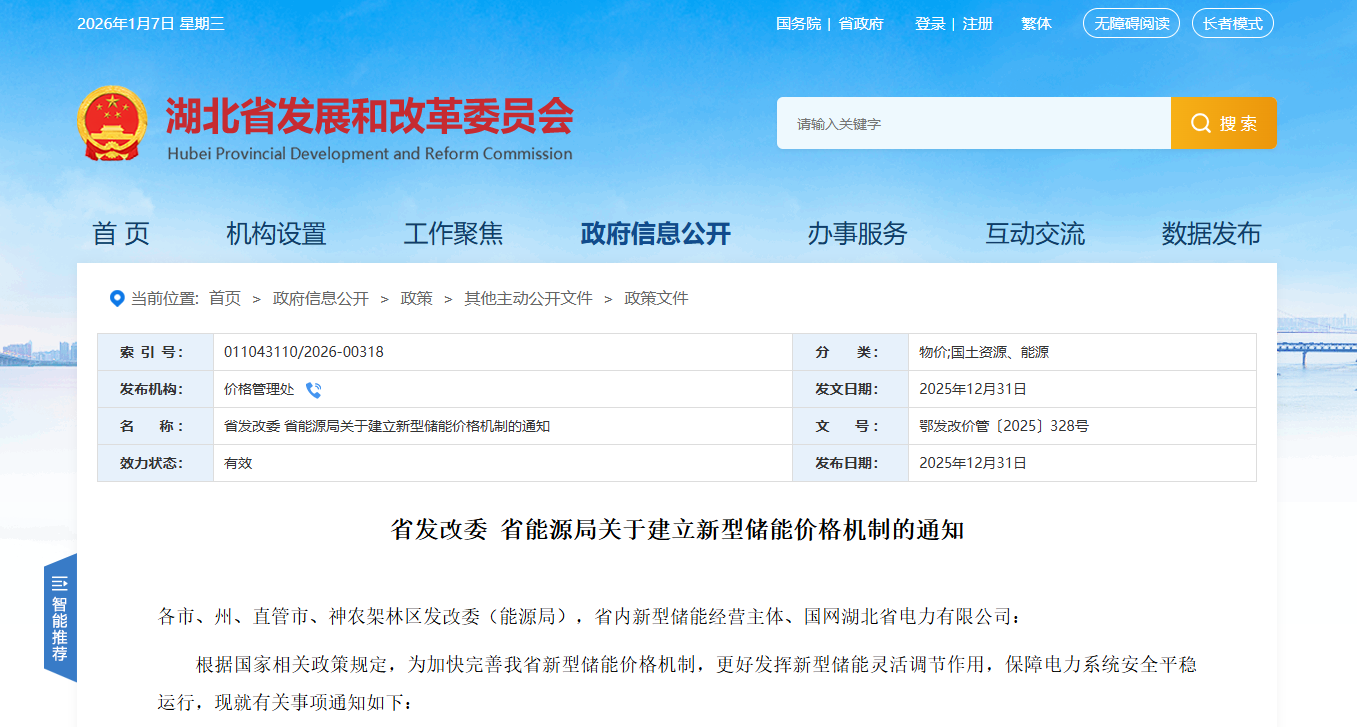
Notice from the Provincial Development and Reform Commission and the Provincial Energy Bureau on Establishing a New-Type Energy Storage Pricing Mechanism
Relevant departments of the provincial government, including the Development and Reform Commission (Energy Bureau) of each city, prefecture, directly administered city, and Shennongjia National Forest Region, as well as the provincial-level entities engaged in new-type energy storage operations, and State Grid Hubei Electric Power Company:
In accordance with relevant national policies and regulations, in order to accelerate the improvement of the price mechanism for new-type energy storage in our province, better leverage the flexible regulation role of new-type energy storage, and ensure the safe and stable operation of the power system, the following matters are hereby notified:
I. Clarify the charging and discharging price mechanism for new energy storage
(1) New energy storage on the grid side. New energy storage that is directly connected to the public grid, has independent metering conditions, and is subject to unified dispatch by the power dispatching authority (including independent energy storage and energy storage built outside of new energy power stations) should participate in the spot market in accordance with the rules. The charging and discharging prices are determined by the market. The charging and discharging electricity consumed for grid connection shall pay the line loss fees in the grid connection process, the electricity price for transmission and distribution, and the system operation fees. Based on the discharge electricity for grid connection each month, the policy-based cross-subsidies in the policy-related cross-subsidies that were paid for the previous charging shall be refunded or deducted. During the period when it is not participating in the market, the charging and discharging electricity for grid connection shall be subject to the low-peak electricity price for two-part system users at the same voltage level after deducting government funds and surcharges, and the discharge electricity for grid connection shall be subject to the agency purchase electricity price. The rules for refunding or deducting the related fees are the same.
(2) New energy storage on the power supply side. New energy storage facilities that are built within new energy power stations and do not directly connect to the public power grid should participate in the spot market in accordance with the rules, and follow the same power generation and consumption price policies as the affiliated new energy power stations for overall electricity settlement. During periods when they are not participating in the market, the off-grid electricity charges obtained by charging from the public power grid should be calculated by deducting the power plant electricity consumption of the affiliated new energy power station from the off-grid electricity consumption measured at the metering point of the affiliated new energy power station, and should be subject to the low-peak electricity price of two-part tariffs for agents purchasing electricity at the same voltage level.
(3) New energy storage at the user end. The new energy storage at the user end is regarded as a whole entity with the user it belongs to. Its electricity consumption characteristics are consistent with those of the user, and the charging price follows the same price mechanism as that of the user. In principle, it does not actively discharge electricity to the power grid.
II. Establish an independent energy storage capacity compensation mechanism on the power grid side
(4) Scope of capacity compensation implementation. For independent energy storage within the new energy storage on the power grid side, a capacity compensation mechanism shall be established. The provincial development and reform commission, the provincial energy bureau, and the provincial power company, in conjunction with the provincial power grid company, will regularly publish a list of grid-side independent energy storage projects that are included in the capacity compensation scope. Projects that enjoy capacity compensation are not allowed to lease capacity.
(V) Capacity Compensation Execution Standard. The monthly capacity electricity charge is determined based on the monthly capacity electricity price and the monthly average available capacity. Specifically, the monthly capacity electricity price = annual capacity electricity price / 12. The annual capacity electricity price is temporarily set at 165 yuan per kilowatt per year. The monthly average available capacity = ∑ (daily available discharge power × single sustainable discharge duration ÷ 10 hours) / total number of days in the month. The relevant parameters for the monthly average available capacity should be reported by the new energy storage project to the power dispatching agency before the next month (adjustments can be made in advance), and the power dispatching agency will make the determination based on the relevant rules for coal-fired power capacity electricity prices.
(6) Capacity-based electricity bill settlement. For the grid-side independent energy storage included in the capacity compensation scope, the monthly capacity-based electricity bill will be calculated according to the rules starting from the following month. The capacity-based electricity bill will be included in the system operation fee and will be shared by all industrial and commercial users. It will be settled on a monthly rolling basis.
(7) Capacity Electricity Charge Assessment. The power dispatching agency conducts monthly verification of the actual adjustable capacity of relevant projects and compiles the assessment results. Based on the relevant assessment rules for coal-fired capacity electricity charges, it is used as the basis for capacity electricity charge settlement. If the actual maximum discharge power or single discharge quantity of the project fails to reach 98% of the declared value in the previous day and also fails to reach 98% of the planned value, one assessment will be recorded for each occurrence. If it happens twice within a month, 10% of the capacity electricity charge for that month will be deducted. If it occurs three times, 50% will be deducted. If it occurs four times or more, 100% will be deducted. For projects where the cumulative total of all monthly capacity electricity charges being fully deducted within a natural year is three times, their capacity compensation eligibility will be revoked. If the annual equivalent charging and discharging times of the project are too low (electrochemical energy storage less than 240 times, compressed air energy storage less than 180 times), 20% of the capacity electricity charge will be recovered for that year and used to offset the system operation costs. The annual equivalent charging and discharging times = (actual charging quantity + actual discharging quantity) / (rated charging quantity + rated discharging quantity).
III. Improving Related Supporting Policies
(8) Strengthening Market Mechanisms. Accelerate the improvement of power market rules that are suitable for new energy storage, clearly define market access requirements, and continuously refine the declaration and clearing methods for power generation and consumption curves. Support new energy storage to participate in the power auxiliary service market in accordance with the rules, and obtain income by providing auxiliary services such as frequency regulation.
(IX) Optimize the dispatching mechanism. For new energy storage systems participating in the market, dispatching operations should be arranged based on the market clearing results as much as possible; for new energy storage systems not participating in the market, the utilization should be carried out in a coordinated manner considering factors such as system safety regulation and the need for clean energy consumption. The deviation electricity generated due to the dispatching of various new energy storage systems based on system safety requirements shall be calculated separately. The deviation electricity for charging and discharging shall be subject to the grid-side energy storage charging and discharging price mechanism.
(10) Provide smooth connection services. During the period when new energy storage is not participating in the market, the power grid enterprise will match the power sources for the charging of new energy storage, and the price difference losses and gains will be included in the system operation costs; the discharged electricity will be used as the source for agency power purchase, and it will be uniformly purchased by the power grid enterprise. The power grid enterprise should provide fair transmission and distribution, grid connection and metering services for new energy storage, and properly handle the electricity fee settlement in accordance with regulations.
This notice shall come into effect on February 1, 2026, with a tentative implementation period of one year. In the event that the country formulates or adjusts relevant policies in the future, they shall be implemented in accordance with national regulations.
Hubei Provincial Development and Reform Commission
Hubei Provincial Energy Bureau
December 31, 2025